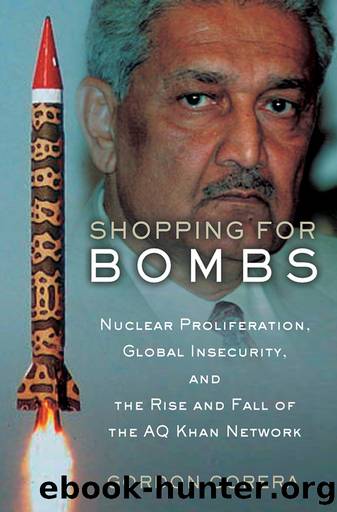
Shopping for Bombs : Nuclear Proliferation, Global Insecurity, and the Rise and Fall of the A.q. Khan Network (9780199885428) by Gordon Corera
Author:Gordon Corera [Corera, Gordon]
Language: eng
Format: azw3, mobi, epub
Publisher: Oxford Univ Pr
Published: 2006-11-15T00:00:00+00:00
WASHINGTON, D.C.
September 2001
THE HEAD OF PAKISTANâS POWERFUL INTER-SERVICES INTELLIGENCE AGENCY (ISI), Lieutenant General Mahmood Ahmed, had arrived in Washington a few days earlier. He and his wife had flown over on a CIA plane for the standard tour given to visiting heads of foreign intelligence agencies. But with the attack on the twin towers and the Pentagon, suddenly the visit took on a much more serious purpose. It was immediately clear that Pakistanâs help would be required in dealing with Osama bin Laden in neighboring Afghanistan. Mahmood was summoned early the next morning along with the Pakistani ambassador to Washington, Maleeha Lodhi, to see Richard Armitage, the pugilistic, barrel-chested deputy secretary of state. A plain-speaking former soldier, Armitage long had been seen by Islamabad as a friendly voice ever since his time as a Pentagon official in the 1980s when he travelled to the country to keep tabs on the Afghan campaign. But Armitage and his boss Colin Powell had decided to deal with Pakistan head on. Armitage delivered a tough message, so tough that Mahmood would complain that heâd been positively rude. Armitage pointed to a decoration sitting in his office that he had received from the government of Pakistan and said that if Islamabad did not help now, he would send it back and no American would ever want another decoration from the country. The United States wanted the Taliban gone in order to get to Osama bin Laden. He offered Pakistan a simple choice: side with the United States or the Taliban. âYou are either 100% with us or 100% against us,â he told them. âThereâs no grey area.â1 Mahmood was taken aback by the brusqueness of someone supposed to be a friend. He protested and said that Washington had to understand the history of Pakistanâs involvement with the Taliban, which Pakistan and particularly the ISI had sponsored since the mid-1990s. Mahmood himself had been one of the strongest proponents of the ISIâs relationship with the Taliban. History was one thing, but the future begins today, Armitage replied, telling him to come back the following day. Armitage and Secretary of State Powell spent that afternoon working on a list of seven demands that were delivered to Mahmood on his return. Mahmood was told it was a list, not an a la carte menu, and that a swift reply from Musharraf was expected. It was all or nothing. Dealing with A. Q. Khan was not on the State Department list. Terrorism was now the overriding priority.
Mahmood called President Musharraf who made his decision immediately. By 3 P.M. that same day, at a second meeting, Armitage was given his answer and he followed up with detailed requests for logistical and intelligence support in dealing with Al Qaeda and ousting the Taliban. There had been debate within Pakistanâs leadership for a number of years over the costs of supporting the Taliban, but the military, including Musharraf, had been among the most ardent supporters of ensuring that Pakistan had a client regime in Afghanistan to provide âstrategic depthâ against India.
Download
Shopping for Bombs : Nuclear Proliferation, Global Insecurity, and the Rise and Fall of the A.q. Khan Network (9780199885428) by Gordon Corera.mobi
Shopping for Bombs : Nuclear Proliferation, Global Insecurity, and the Rise and Fall of the A.q. Khan Network (9780199885428) by Gordon Corera.epub
This site does not store any files on its server. We only index and link to content provided by other sites. Please contact the content providers to delete copyright contents if any and email us, we'll remove relevant links or contents immediately.
| Elections & Political Process | Ideologies & Doctrines |
| International & World Politics | Political Science |
| Public Affairs & Policy | Specific Topics |
| United States |
The Secret History by Donna Tartt(19012)
The Social Justice Warrior Handbook by Lisa De Pasquale(12179)
Thirteen Reasons Why by Jay Asher(8878)
This Is How You Lose Her by Junot Diaz(6866)
Weapons of Math Destruction by Cathy O'Neil(6254)
Zero to One by Peter Thiel(5778)
Beartown by Fredrik Backman(5725)
The Myth of the Strong Leader by Archie Brown(5488)
The Fire Next Time by James Baldwin(5421)
How Democracies Die by Steven Levitsky & Daniel Ziblatt(5207)
Promise Me, Dad by Joe Biden(5138)
Stone's Rules by Roger Stone(5073)
A Higher Loyalty: Truth, Lies, and Leadership by James Comey(4944)
100 Deadly Skills by Clint Emerson(4908)
Rise and Kill First by Ronen Bergman(4766)
Secrecy World by Jake Bernstein(4735)
The David Icke Guide to the Global Conspiracy (and how to end it) by David Icke(4693)
The Farm by Tom Rob Smith(4498)
The Doomsday Machine by Daniel Ellsberg(4477)
